Get Our RSS Feed!
Front Porch Blog

Jeff Deal


Lover of Appalachia, Renewable Energy, Local Green Sustainable Economies, and Energy Efficiency. Information Technology Specialist for Appalachian Voices


Raleigh Legislature Hosts Citizens’ Lobby Day for Renewable Energy


Tuesday, June 19th, 2012 | Posted by Jeff Deal


There’s just something fitting about North Carolina renewable energy advocates getting up ahead of the sun – and this is exactly what they did on Tuesday June 12th as they rolled out of bed for the 7:00 AM convening of the North Carolina Sustainable Energy Society’s Citizen Lobby Day.

Why such an early start? Renewable Energy Development in NC of course! Though the waiting hot coffee didn’t hurt.

Given the many arduous budgetary matters now before NC’s legislature, these NC fans of clean and green energy wanted to make sure that the legislature kept renewable energy development in North Carolina (now the 10th largest state in the Union), squarely on on the front burner.

Read more
...


U.S. Renewable Energy Production Surpasses Nuclear in 2011


Thursday, January 19th, 2012 | Posted by Jeff Deal


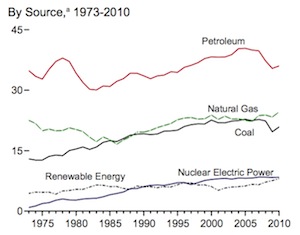
For the first time since the late 90s, energy produced by renewable sources (biomass, hydroelectric, wind, geothermal and solar) has surpassed the amount of energy produced by nuclear plants in the U.S., according to the most recent Monthly Energy Review from the U.S. Energy Information Administration (EIA). Link to the report.

The report shows that 6.944 quadrillion Btu’s (quads) were generated by renewable sources during the first nine months of 2011, 12.5% more than the 6.173 quads generated by nuclear power plants during this time. Of the 6.944 quads produced by renewable sources, 47.85% comes from biomass (wood, organic waste, and biofuels), 36% comes from hydroelectric, 12% from wind, 2.4% from geothermal and 1.25% from solar (photovoltaic). Although as Amitabh Pal comments in an article for The Progressive, “the ‘renewable’ category here is a bit of a catch-all, since it includes sources that are somewhat dubious from a clean energy standpoint, such as biofuels.”

Nonetheless, this marks a hopeful turning point in our country’s quest for a clean energy future. Growth in the renewable energy sector continues unabated, in spite of global recession. Looking at another EIA report, Ken Bossong notes that, “compared to the first three quarters of 2010, solar-generated electricity expanded in 2011 by 46.5%; wind by 27.1%, geothermal by 9.4%, and biomass by 1.3%.” Nuclear generation, by comparison, decreased by 2.8% during the same time period.

The number of operable nuclear facilities in the U.S. increased from 42 in 1973 to a maximum of 112 in 1990. Since 1998, the count has held steady at 104. “Operable” is a liberal term, “in that it does not exclude units retaining full-power licenses during long, non-routine shutdowns that for a time [render] them unable to generate electricity,” opines the EIA. For example, the five Tennessee Valley Authority (TVA) nuclear units active in 1985 (Browns Ferry 1,2 and 3; Sequoyah 1 and 2) were shut down under a regulatory forced outage, and restarted in 1991, 1995, 1988, and 1988, respectively. However, during this time each was considered “operable” by the EIA.

While TVA is attempting to reanimate a “zombie” plant , the Bellafonte 1 reactor, and to finalize the Watts Bar 2 reactor, these plants would only replace soon-to-retire nuclear plants, rather than leading to a net expansion of the U.S. nuclear industry (WaPo).

What’s Clean Air Worth to You?


Monday, January 16th, 2012 | Posted by Jeff Deal


Why is the EPA Advancing the Mercury
and Air Toxics Standard (MATS)?


How much will the EPA’s MATS be worth
to your state? CLICK HERE to find out.

What happens when 40 year old coal-fired electric power plants don’t have modern pollution control systems to remove mercury and other air toxics from their smoke stack emissions? Its not pretty.

These pollutants end up in our environment – and eventually our bodies and those of our neighbors and loved ones.

To safeguard human health against these pollutants, such as mercury – a powerful toxin which effects the brain and nervous system, the Environmental Protection Agency has developed the Mercury and Air Toxics Standard (MATS), which limit these hazardous emissions. To learn more about the EPA’s air toxics standards and how they protect the health of you and your state, visit their website at:

http://www.epa.gov/mats/.

Renewable Energy Growing, but Not Fast Enough


Friday, December 2nd, 2011 | Posted by Jeff Deal


Check out this EXCELLENT post at Grist HERE concerning the rapid, but still too slow growth of renewable energy development in the US. The news is worse for we Folks here in the Southeast. From the post:

The state maps showing the concentration of various renewables (too many to show here) also implicitly illuminate the nature of the political problem in the U.S., namely: the South doesn’t have much clean energy. Or rather, they have biomass, but that’s about it. (Good thing for policymakers to keep in mind: if you want the South on board, include biomass.)

The “gist” from Grist seems to be that the We in the Southeast need more electricity generated from solar and wind … and we need it fast!


Renewable Energy Growth by Sector in the US Since 2000


The NC Sustainable Energy Association’s “Making Energy Work” Conference: NC a Leader in the Southeast’s Clean Energy Economy


Thursday, November 17th, 2011 | Posted by Jeff Deal


NCSEA’s annual meeting and conference, Making Energy Work, highlighted many green energy victories for North Carolina in 2011:

  • the renewable energy and energy efficiency sectors generated $3,100,000,000 in gross revenues for the year
  • North Carolina is home to two of the Nation’s fastest growing Fortune 50 companies – both renewable energy businesses

  • the clean energy sector is responsible for 14,800 “full time equivalent” jobs
  • the clean energy sector grew by 18.4 percent
  • clean energy firms have offices located in 87 of North Carolina’s 100 counties
  • the state boasts 1,500 commercial and government energy efficient buildings – roughly 130 million square feet

Speakers and attendees widely noted that far more benefits from this economic sector exist via improvements to the State’s Renewable Energy Portfolio Standard and state level energy efficiency programs for the homes and businesses of North Carolina’s 9 million plus citizenry.

For more information, read NCSEA’s 2011 Renewable Energy and Energy Efficiency Industries Census HERE.

High Point Duke Energy Rate Hike Hearing Turns Out Large Crowd in Opposition to Increase


Friday, October 28th, 2011 | Posted by Jeff Deal


If Duke Energy was listening to the citizens gathered at High Point’s City Hall last night, they sure got a burning earful! Over one hundred private citizens turned out to express their extreme displeasure with Duke Energy’s attempt to return a profit to their investors at the expense of North Carolina rate payers in the midst of a serious economic downturn.

“I’d rather be robbed at gunpoint than ball point” one Duke Energy customer stated. The same individual went on to express his grave dissatisfaction with Duke’s self-interested initiative to raise electricity rates, even as many residents were trying “to make a dollar out of fifty cents” and choosing between “eating or heating”.

While individuals were noticeably upset by the proposed rate hike, their comments were thoughtful and many well researched – one speaker even going so far as to review his Duke Energy bills and statements for the last several years to demonstrate a trend in rising charges by the utility giant and another providing a cogent economic analysis of the many free-market failures and contradictions of NC’s electricity market and Duke Energy’s business model.

At least 10 activists from the Occupy Greensboro movement attended the event, holding the proposed rate increase up as another example of affluent corporate overreach and greed paid for at the expense of most Americans.

At least 3 television news crews, 1 NPR reporter and three Piedmont newspapers were on hand for the event.

Read more about the event at the web sites below:

NPR’s Planet Money Talks About the True Cost of Coal


Wednesday, October 26th, 2011 | Posted by Jeff Deal


Just how much do we pay for environmental pollution? How much are polluters taxing the health of our communities, families and friends? Find out by listening to Planet Money’s podcast on the true full cost of coal and other forms of environmental pollution HERE.

The Economic Cost of Environmental Pollution

Blair Mountain Community Center and Museum Opens


Wednesday, September 7th, 2011 | Posted by Jeff Deal


A note from Chuck Keeney, Secretary of the Friends of Blair Mountain:

Since the “March on Blair Mountain: Appalachia is Rising” event, some coal industry executives have claimed that if our preservation efforts succeed and Blair Mountain is spared from mountaintop removal, the “fabric of the community” will be destroyed. We at Friends of Blair Mountain disagree and are putting our words into action.

On September 4, we held the grand opening of the Blair Mountain Community Center and Museum. Located two miles north of the historic battlefield, the facility will serve as a catalyst for community revitalization, education and historic preservation. In addition to museum exhibits, we plan to offer a coal heritage archive for research, a library of relevant books, music collection and films. There will be space for musical performances, activist gatherings, workshops, history tours and some good ole’ Appalachian gatherings of fellowship and fun.

The Blair Mountain Community Center and Museum is a place to display the pride of Appalachian culture and the depth of coalfield heritage while building a healthier, cleaner and more economically diverse Appalachia.

For more information or to learn about how you can help our grassroots efforts, go to www.friendsofblairmountain.org or call our Community Center and Museum staff at (304) 369-9800

You can also read the press release here.

Spread the News! Appalachians overwhelmingly oppose mountaintop removal


Thursday, August 18th, 2011 | Posted by Jeff Deal


The following email was sent to the 100,000+ supporters of iLoveMountains.org. To sign up to receive free email alerts, click here.

Great news! This week we received the results of a public opinion poll that confirms that voters in Appalachia overwhelmingly want to end mountaintop removal and strengthen protections provided by the Clean Water Act.

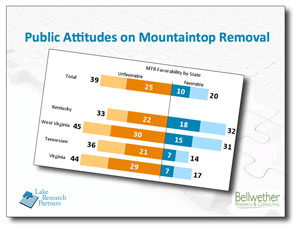
A new poll commissioned by Appalachian Mountain Advocates, Earthjustice and the Sierra Club shows staggering support for ending mountaintop removal coal mining in Appalachian coal mining states. Conducted by two bipartisan firms, the poll has revealed that 57% of informed voters oppose the practice, versus 20% approving.

And even more astoundingly, when asked about increasing Clean Water protections on mountaintop removal, 78% of respondents supported increasing Clean Water Act protections, with just 9% opposing.

This announcement comes on the heels of a national poll released by CNN last week, showing that Americans across the country oppose mountaintop removal 57% to 36%.

People like you have made it clear for a long time that the majority of citizens in the U.S. oppose mountaintop removal. This poll puts to rest out-of-date perceptions that Appalachians support mountaintop removal.

These two polls give us great leverage to demand that our elected officials follow their moral compass, follow the science, and follow regional and national public opinion by ending mountaintop removal. Please take a moment to write your congressperson about this poll to make sure that they see these figures.
www.iLoveMountains.org/we-dont-want-MTR

For the Mountains,
Matt Wasson

Guest Blogger: Chuck Keeney – What’s next for Blair Mountain


Friday, July 29th, 2011 | Posted by Jeff Deal


Cross posted from iLoveMountains.org

C. Belmont Keeney, or Chuck as most people know him, has a Ph.D. in Appalachian and American History from West Virginia University. His great grandfather, Frank Keeney, was president of the United Mine Workers of America and helped organized the Miners March in 1921. Chuck was one of the principle organizers of the June 2011 March on Blair Mountain.

Since Chuck is an active board member of Friends of Blair Mountain, we asked him to summarize last month’s march and tell us what’s next for Blair Mountain:

Two weeks after the June 2011 March on Blair Mountain, I accompanied Brandon Nida, a doctoral candidate in archeology at U.C. Berkeley and a good friend, on a day long trip back to the community of Blair. It was a Sunday, overcast and rainy, unlike the sunny mid-ninety degree temperatures under which we marched a couple of weeks before. Everyone who marched remembers the heat. But on this day, Brandon and I drove a nice, air conditioned car down 119 South to Six Mile Road and then winded down the curvy Route 17 through the mountains and into Logan County. To be honest, it is difficult to describe what I felt as we drove by so many familiar sights along portions of the March route. We passed by a lovely country home where, during the March, an old lady invited us to stop and eat lunch. As it turned out, this lady was the granddaughter of a woman who fed the miners during the 1921 March and we found ourselves resting under the shade of the very trees where rebellious miners had been ninety years before. We passed by homes where people applauded us and homes where people reviled us. I have lived my entire life in West Virginia, spent years studying the history of Appalachia, and yet I think I only truly saw my home for the first time from June 6-11, 2011 when hundreds of activists and concerned citizens marched the fifty miles from Marmet to Blair Mountain, West Virginia.

The story of the March itself is different for everyone who participated in it. Much has already been written about it as the people begin to tell their stories. No doubt, much more will be written, and I look forward to seeing what tales emerge from this memorable event. For myself, suffice it for the moment to say, I met many incredible people, formed friendships, and renewed some old ones, which have changed my life in ways I never would have anticipated before. I have met union miners, proud mountaineers, environmentalists, lawyers, scholars, and even people who believed so greatly in the justice of our cause that they crossed oceans in order to make their voices heard. To say that the march has been inspiring is an understatement. But in spite of the profound experience of the march and the attention that we have received around the nation and even the world, Blair Mountain is still in danger and we still have to save it. So as I drove from Charleston to Blair with Brandon and revisited so many places burned into my memory, one overarching question emerged:

What do we do now?

Read more
...


Boulder crashes through home in Perry County


Wednesday, July 27th, 2011 | Posted by Jeff Deal


Cross posted from WYMT News:

Federal and state officials are investigating after a boulder came crashing through a Perry County home on July 26.

This was not the first time this quiet community was shaken up.

“It’s shaken in here a many a time, yeah,” said Shirley Campbell, sales clerk at Campbell’s Station in Dice, Kentucky.
“They’ve been letting shots off, but they’ve never been that bad.”

A home on bailey way in dice was damaged when a boulder fell through the bedroom ceiling.

“It was probably about as big as a basketball,” said Orby Dean Campbell, describing the rock that came in through the roof and exited through the bedroom wall. Campbell owns the trailer which was damaged at around 11 a.m.

Campbell said his daughter and her husband were inside the home with their children, 6-year-old and 2-year-old boys, at the time of the accident.

“It could have killed every one of them if they’d been in there,” said Campbell.

Workers in the area said they heard what happened from about a half-mile away. Shirley Campbell was working at Campbell’s Station when she heard that her niece’s residence had been affected.

“I seen all of that smoke and it was all at once, just come right up,” said Shirley Campbell.

Orby Campbell said that the boulder came down from the mountain above the home. He said he believes blasting at a nearby mine is to blame.

“I want them to know to lighten on those shots back there if they are gonna work back there – lighting those shots can kill people,” said Campbell.

He said he was thankful nothing worse had happened. No one was injured in the incident.

The Division Of Mine Reclamation Enforcement, DMRE, surface mine inspectors and the explosives and blasting branch are investigating along with MSHA and the OSM, Office of Surface Mining to determine the cause. Officials from DMRE said it will be a thorough investigation and will likely take several days.

State mining officials are not able to determine if the boulder came from the nearby mining company.


Breaking: New Study Links Mountaintop Removal to 60,000 Additional Cancer Cases


Wednesday, July 27th, 2011 | Posted by Jeff Deal


by Jeff Biggers, cross posted from Alternet.org
Among the 1.2 million American citizens living in mountaintop removal mining counties in central Appalachia, an additional 60,000 cases of cancer are directly linked to the federally sanctioned strip-mining practice.

That is the damning conclusion in a breakthrough study, released last night in the peer-reviewed Journal of Community Health: The Publication for Health Promotion and Disease Prevention. Led by West Virginia University researcher Dr. Michael Hendryx, among others, the study entitled “Self-Reported Cancer Rates in Two Rural Areas of West Virginia with and Without Mountaintop Coal Mining” drew from a groundbreaking community-based participatory research survey conducted in Boone County, West Virginia in the spring of 2011, which gathered person-level health data from communities directly impacted by mountaintop mining, and compared to communities without mining.

“A door to door survey of 769 adults found that the cancer rate was twice as high in a community exposed to mountaintop removal mining compared to a non-mining control community,” said Hendryx, Associate Professor at the Department of Community Medicine and Director of West Virginia Rural Health Research Center at West Virginia University. “This significantly higher risk was found after control for age, sex, smoking, occupational exposure and family cancer history. The study adds to the growing evidence that mountaintop mining environments are harmful to human health.”

Bottom line: Far from simply being an environmental issue, mountaintop removal is killing American residents.

Read the entire article on Alternet.org

[VIDEO EXTRA]: Jimmy Weekley, Paul Corbit Brown, and Blair Mountain


Friday, July 15th, 2011 | Posted by Jeff Deal


Expect the President to Veto H.R. 2018 – Clean Water Cooperative Federalism Act


Tuesday, July 12th, 2011 | Posted by Jeff Deal


EXECUTIVE OFFICE OF THE PRESIDENT
OFFICE OF MANAGEMENT AND BUDGET
WASHINGTON, D.C. 20503

July 12, 2011
(House Rules)

STATEMENT OF ADMINISTRATION POLICY
H.R. 2018 – Clean Water Cooperative Federalism Act
(Rep. Mica, R-FL, and 39 cosponsors)

The Administration strongly opposes H.R 2018 because it would significantly undermine the Clean Water Act (CWA) and could adversely affect public health, the economy, and the environment.

Under the CWA, one of the Nation’s most successful and effective environmental laws, the Federal Government acts to ensure safe levels of water quality across the country through the Environmental Protection Agency (EPA). Since the enactment of the CWA in 1972, the Federal Government has protected the waterways our citizens depend on by using its checks and balances authority to review and adjust key State water pollution control decisions, where necessary, to assure that they reflect up to date science, comply with the law, and protect downstream water users in other States. H.R. 2018 would roll back the key provisions of the CWA that have been the underpinning of 40 years of progress in making the Nation’s waters fishable, swimmable, and drinkable.

H.R. 2018 could limit efforts to safeguard communities by removing the Federal Government’s authority to take action when State water quality standards are not protective of public health. In addition, it would restrict EPA’s authority to take action when it finds that a State’s CWA permit or permit program is inadequate and would shorten EPA’s review and collaboration with the Army Corps of Engineers on permits for dredged or fill material. All of these changes could result in adverse impacts to human health, the economy, and the environment through increased pollution and degradation of water bodies that serve as venues for recreation and tourism, and that provide drinking water sources and habitat for fish and wildlife.

H.R. 2018 would disrupt the carefully constructed complementary CWA roles for EPA, the Army Corps of Engineers, and States in protecting water quality. It also could eliminate EPA’s ability to protect water quality and public health in downstream States from actions in upstream States, and could increase the number of lawsuits challenging State permits. In sum, H.R. 2018 would upset the CWA’s balanced approach to improve water quality across the Nation, risking the public health and economic benefits of cleaner waters.

If the President is presented with this legislation, his senior advisors would recommend that he veto the bill.

* * * * * * *

Amelia Salzman
Associate Director for Policy Outreach
White House Council on Environmental Quality

1,000 Rednecks Marched on Blair Mountain!


Tuesday, July 5th, 2011 | Posted by Jeff Deal


The following email was sent to the 51,000+ supporters of iLoveMountains.org. To sign up to receive free email alerts, click here.

Just a few weeks ago citizens of Blair, WV climbed to the crest of Blair Mountain with over 1,000 new allies. Movement leaders from surrounding states, union workers, students, archaeologists, activists, and friends from neighboring counties and across the country all came together for Appalachia Rising: March on Blair Mountain.

This rally, this stand, was the culmination of a week long march to save the historic Blair Mountain, end mountaintop removal, strengthen labor rights, and demand sustainable jobs for all of central Appalachia. Click here to see footage of the march!

300 marched the 50 miles through the 100 degree heat to meet another 700 on top of Blair Mountain. Thousands joined us for a virtual march online, and across the nation, people heard our stories from over 300 articles covering the march.

We are proud to have been a part of this historic event with you, it would have not been possible without the growing grassroots presence around the US supporting these efforts. See the video here.

This week opens new doors in Blair and new doors for our movement. We have shown that we can struggle through intimidation, we can forge new alliances, we can overcome obstacles and that we will be stronger in the end.

Let’s move forward together! More details on the event and what’s next for Blair can be found at iLoveMountains.org/Blair-Mountain and MarchOnBlairMountain.org.

Thank you for your continued dedication: what we accomplished with the March on Blair is representative of what we are doing throughout the entire region impacted by mountaintop removal, and we couldn’t do that without you!

For the mountains,

Matt Wasson
iLoveMountains.org

Voice Your Support for Cleaner Air


Thursday, May 26th, 2011 | Posted by Jeff Deal


Coal plants = #1 source of mercury into our air. Bonding with water and falling from the air, mercury deposits in our lakes, rivers, streams, and other water bodies that provide drinking water, fish, recreation and ecological habitats. Read here & learn about mercury’s toxic effects.
Right now, you can take a stand to reduce mercury emissions from coal plants across the country. Click here to take action.

This past March, the EPA submitted stronger regulation standards for mercury, acid gases, and other toxic air pollutant emissions from power plants. Through July 5th, 2011, you can send a public comment to EPA Administrator Jackson in support of this progressive measure. There will be public hearings in Chicago (May 24), Philadelphia (May 24), and Atlanta (May 26). Comments can come in the form of letters, emails, or videos to be shown at public hearings.

A local example of mercury’s far reaching toxicity is Watauga Lake in Tennessee. As shown in the video below, Watauga Lake is a pristine, high elevation mountain lake with no direct pollution sources. Yet, the lake is listed under the Tennessee Department of Environment and Conservation’s precautionary fish advisory due to high mercury levels in fish tissue. Women who are nursing or pregnant and young children are advised not to eat these fish so as to reduce the risk of developmental and neurological deficiencies in children.

Clean air and water are human rights that must be protected from coal industry pollution. Your comment will only take a few minutes, but can help prevent years of environmental destruction from air toxins.

Voice your support for stronger EPA regulation of mercury and other air toxins HERE.

FOIA Lawsuit Filed to Gain Peabody Coal-Mining Records for Operations on Tribal Lands in Northeast Arizona


Friday, October 8th, 2010 | Posted by Jeff Deal


The Black Mesa Mine

Read more about the suit at the following links below:

Solar Power Now Cheaper than Nuclear in North Carolina


Monday, July 12th, 2010 | Posted by Jeff Deal


The cost of nuclear generated electricity
vs. solar generated electricity

Check out the rest of the post on FacingSouth’s Blog HERE.


Below is a teaser to tide you over until the FacingSouth Blog loads:

The report points out that both new solar and new nuclear power sources will cost more than present electricity generation. However, power bills will rise less with solar generation than with new nuclear.

Duke Energy and Progress Energy, North Carolina’s largest utilities, estimate that proposed new nuclear plants would generate power at a cost of 14 to 18 cents per kilowatt-hour. But commercial-scale solar developers are already offering utilities electricity at 14 cents or less per kWh.

Today an average North Carolina homeowner can have a solar electricity system installed for a net cost between $8,200 and $20,000 or more, depending on generation capacity.

Take Action: Support Miners and Communities


Thursday, April 29th, 2010 | Posted by Jeff Deal


The following email was sent to the 41,800 supporters of iLoveMountains.org. To sign up to receive free email alerts, click here.

mine safety

On Sunday, a memorial service was held for the 29 miners who were killed earlier this month in the explosion at Massey Energy’s Upper Big Branch Mine in Raleigh County, West Virginia.

The loss of these courageous men is a terrible tragedy, and as President Obama said in his eulogy, “Our task, here on Earth, is to save lives from being lost in another such tragedy.”

We agree. Mining — whether surface or underground — is an extremely dangerous occupation. More than 300 people have died mining coal in the United States in the past 10 years. Every day, three people die from black lung disease as a result of having worked in coal mines.

Yet the inherent dangers of coal mining are exacerbated by companies like Massey Energy, whose corner-cutting mentality has led to unsafe working conditions at the Upper Big Branch Mine and other facilities. Massey is also the number one producer of mountaintop removal coal in the country and, in 2008, was assessed the largest penalty in the history of the Clean Water Act.

Congressman Nick Rahall, Chairman of the Natural Resources Committee and long time leader in protecting miner safety, represents the district where the accident occurred. He recently said, “this mining catastrophe shows us that there is still much more that must be done to protect those who enter the mines each day working to support their families.”

You have been instrumental in the recent victories to protect Appalachian communities from the permitting of new mountaintop removal mines. While there’s much that still needs to be done to end mountaintop removal permanently, today we ask you to help protect those communities in a different way.

Will you please take a moment to sign this letter supporting Congressman Rahall’s efforts to strengthen protections for our nation’s coal miners?

Lorelei Scarbro, a community organizer with Coal River Mountain Watch, whose husband died of black lung and whose has family that works at the Upper Big Branch Mine, will hand deliver the letter of support to his office.

Please join Lorelei in supporting Congressman Rahall’s stance on miner safety. Safe working conditions are just another aspect of protecting the people of Appalachia from the impacts of irresponsible coal mining.

Please add your name to the letter today.

Sincerely,

Matt Wasson
iLoveMountains.org

Terrible news from Raleigh County, WV


Tuesday, April 6th, 2010 | Posted by Jeff Deal


“25 miners were killed, and 4 remain missing, in a Raleigh County WV coal mine.”

April 5th, 2010 – Background information
April 6th, 2010 – Press briefing from officials
April 6th, 2010 – Update from the WV Governor

The Appalachian Voices’ family – our staff, our friends, and our respective communities – hold the families of Raleigh County in our thoughts and prayers today. The sudden loss of these courageous men is unspeakable, and we encourage any and all efforts to see that no similar tragedy ever befalls our region again.

There ought be a monument to America’s coal miners in every town and city in the United States. As Jeff Goodell says, coal helped the US win two world wars and build the strongest national economy the world has ever seen. But, Appalachia can no longer be a national sacrifice zone. Our miners, our mountains, and our communities are non-negotiable.

We stand ready to join coalfield communities and Appalachian elected officials in encouraging safe, sustainable ways to grow our communities in Appalachia.